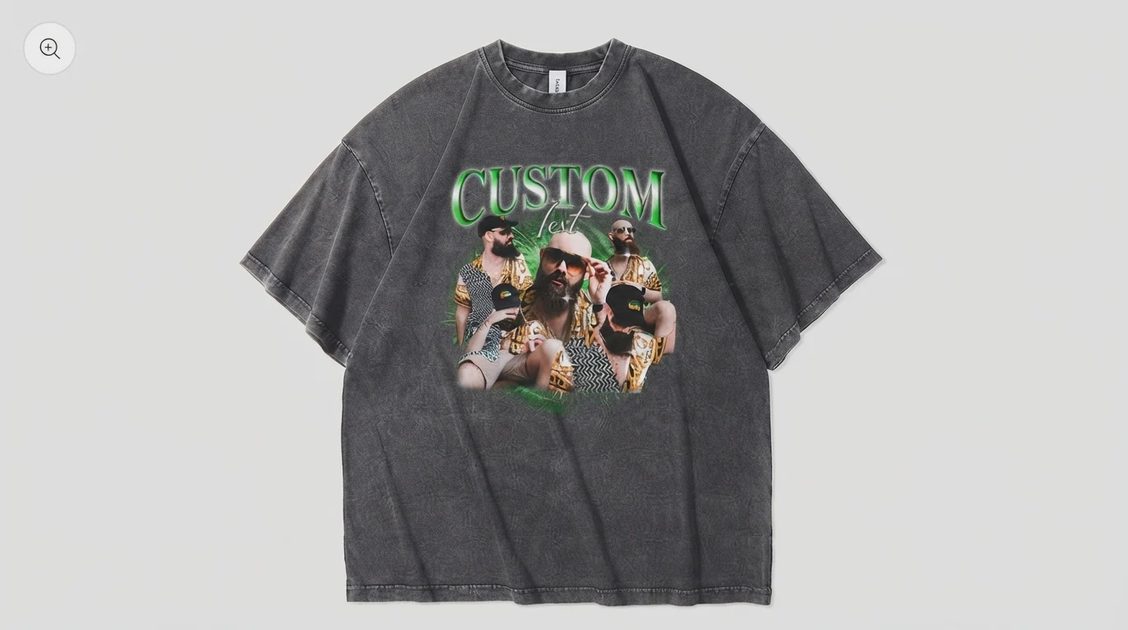
I own a lot of graphic tees. Not because I planned it — they just accumulate. A faded band shirt from a concert I barely remember. A vintage-style one from a thrift store that cost $6 and fit perfectly. A custom one my girlfriend made for my birthday with a photo of our dog that looks nothing like our dog. Point is, I didn't set out to collect them. They just showed up and stayed. So when I came across this guide, I figured I'd share it. Because graphic tees are one of the few things in fashion that actually make sense — they're honest, they're comfortable, and they don't pretend to be something they're not. Here's everything you need to know about them. Whether you're buying your first or your fiftieth.
In This Guide
Open anyone's closet and you'll find at least one graphic tee. Probably five. Whether it's a faded band shirt from a concert years ago, a bold street-art print, or a vintage-style design that just felt right — the graphic tee is one of fashion's most democratic garments. It costs nothing to understand, but rewards those who do.
Graphic tees have long since outgrown the "basic wardrobe item" box. Today, they function as a canvas for self-expression, a snapshot of cultural identity, and — with the rise of custom printing and embroidery — a genuinely personal wearable artifact. This guide covers it all: history, types, styling, care, and how to make one that's entirely your own.

What Is a Graphic Tee?
A graphic tee (also called a graphic t-shirt) is any T-shirt featuring a printed or embroidered design as its defining visual element. That design can be anything: artwork, typography, photography, a logo, an abstract pattern, a cultural reference, or a personal photo. The image is the point.
What separates a graphic tee from a plain tee isn't just decoration — it's intention. Graphic tees communicate something. They signal taste, humor, affiliation, memory, or attitude. The most enduring ones do all five at once.
Common graphic tee design categories include:
Band and music tees — concert merchandise and artist tributes
Film and pop culture — TV shows, movies, iconic moments
Art and abstract prints — collaborations with illustrators and painters
Slogan and typography tees — words that carry weight
Vintage and distressed styles — designed to look like they've lived a life
Photo prints — faces, places, memories rendered in ink on fabric
One-line definition: A graphic tee is the simplest way to wear art — and the most honest way to tell people who you are before you open your mouth.
A Brief History of the Graphic Tee
The graphic tee didn't start as fashion — it started as function, then became a protest, then became a cultural institution. Here's the condensed version:
1950s–60s Brands begin printing logos and mascots on T-shirts as promotional merchandise. The T-shirt shifts from undergarment to outerwear, worn by Marlon Brando in A Streetcar Named Desire and James Dean in Rebel Without a Cause — instantly coded as cool.
1970s Rock music explodes and band tees become the most powerful form of fan merchandise. Led Zeppelin, The Rolling Stones, and The Ramones put graphic tees on stages and in the streets. Wearing the shirt means belonging to the tribe.
1980s Skateboard and surf culture adopt the graphic tee as a uniform. Brands like Thrasher, Stüssy, and Vision Skateboards use bold, hand-drawn graphics to define subculture identity. Screen printing becomes widely accessible, democratizing design.
1990s Hip-hop culture and streetwear push oversized graphic tees into the mainstream. Vintage tees from the '70s and '80s become status symbols. Irony enters the picture — wearing a "bad" graphic knowingly becomes a style statement.
2000s–Now High fashion adopts the graphic tee. Luxury houses release T-shirts that cost hundreds of dollars. Meanwhile, custom on-demand printing makes it possible for anyone to create their own graphic tee in minutes. The form is both democratized and elevated simultaneously.
Main Types of Graphic Tees

By Style
Vintage & Distressed
Faded colors, cracked prints, and worn-in texture. These tees are designed to look like they've been lived in — a deliberate nod to decades past.
Minimalist
A small logo, a single word, or a subtle abstract mark. Understated and versatile — the graphic tee for people who say a lot by saying little.
Streetwear / Oversized
Large-scale prints, bold color blocks, dropped shoulders. Designed to command attention and pair with cargo pants or joggers.
Photo Print
A photograph — a portrait, a landscape, a memory — printed directly onto the fabric with photographic detail. Personal and powerful.
By Print Technique
Technique | Best For | Key Quality |
|---|---|---|
Screen Printing | Bold graphics, large runs | Vivid, long-lasting color |
Heat Transfer | Small batches, complex designs | Flexible, cost-effective |
DTG (Direct to Garment) | Photo-realistic detail | Near-photographic fidelity |
Embroidery | Logos, text, minimalist icons | Dimensional texture, premium feel |
By Cultural Category
Band Tees — Tour merchandise, concert souvenirs, musical identity
Art Collaboration Tees — Designer or artist-created graphics, often limited edition
Brand Logo Tees — Streetwear and luxury labels as wearable signifier
Custom Tees — Entirely personal: your photo, your words, your design
How to Choose and Style Graphic Tees

Choosing the Right Fit
Fit is the foundation. Get this wrong and even a great graphic looks off.
Slim fit — Clean lines, works well for minimalist graphics and smart-casual contexts
Regular fit — The universal fit; adapts to most body types and styling directions
Oversized fit — Streetwear's default. Wear it intentionally: tuck the front, cuff the sleeves, or let it drape deliberately
Matching Graphic Scale to the Occasion
Large, bold graphics → Make the tee the focal point. Keep everything else simple: solid pants, clean sneakers.
Small or subtle graphics → Low-key enough to work in layered or more polished outfits without competing for attention.
Four Outfit Formulas That Always Work
Outfit | Vibe | Occasion |
|---|---|---|
Graphic tee + straight-leg jeans + white sneakers | Classic American | Everyday, weekends |
Graphic tee + cargo pants + chunky skate shoes | Street / Skate | Casual, creative environments |
Graphic tee + tailored blazer + trousers | Smart casual | Creative workplaces, dinners |
Graphic tee + midi skirt + ankle boots | Feminine street | Brunches, gallery visits |
How to Care for Your Graphic Tee
The fastest way to ruin a graphic tee is to wash it wrong. A little care keeps prints and embroidery looking sharp for years.
🔄Wash Inside OutTurn the shirt inside out before every wash to protect the print from friction and abrasion.
🧊Cold Water OnlyHot water degrades print adhesion and causes shrinkage. Cold water washes are gentler on fabric and color.
🚫No BleachBleach destroys printed inks and embroidery threads. Even "color-safe" bleach can cause fading over time.
🌬️Air Dry When PossibleTumble drying on high heat breaks down prints. Lay flat or hang to dry — especially for embroidered pieces.
🔥Iron on ReverseIf ironing is necessary, always iron on the inside of the shirt. Never apply heat directly to a printed or embroidered surface.
🛍️Store FoldedHanging heavy graphic tees can stretch the neckline over time. Fold and store flat for longevity.
The Rise of Custom Graphic Tees

Custom graphic tees have moved from novelty to mainstream — and for good reason. Off-the-rack graphics are designed for everyone, which means they're designed for no one in particular. A custom tee is different: it starts with you.
Why Custom Tees Are Worth It
True uniqueness — No one else owns the same shirt. Full stop.
Emotional resonance — A photo of someone you love, a place that mattered, a date you want to remember. Worn.
Perfect as a gift — Personalized tees are one of the few gifts that feel genuinely considered, not just purchased.
Brand and group identity — For teams, events, families, or small businesses, a custom tee creates belonging.
Custom Photo Print vs. Custom Embroidery: Which to Choose?
Photo Print | Embroidery | |
|---|---|---|
Best for | Photographs, detailed artwork, vintage effects | Text, logos, minimalist icons |
Texture | Flat, smooth print | Raised, dimensional thread |
Feel | Casual, expressive, nostalgic | Premium, refined, lasting |
Durability | Very good with proper care | Exceptional — thread outlasts ink |
✨ Featured at TIUOUS
Two Ways to Make a Graphic Tee That's Yours
TIUOUS specializes in premium custom T-shirts — soft fabrics, thoughtful construction, and two distinct customization paths depending on what you're trying to say.
Frequently Asked Questions

What's the difference between a graphic tee and a printed tee?
The terms are often used interchangeably, but there's a subtle distinction. A printed tee is any shirt with ink applied to it — including simple dye patterns, tie-dye, or all-over prints. A graphic tee is more specific: it features a deliberate, designed image — artwork, typography, photography, or a visual concept — as the centerpiece of the garment. All graphic tees are printed, but not all printed tees are graphic tees.
What fabric is best for graphic tees?
100% cotton is the classic choice — it holds ink well, breathes comfortably, and softens naturally with wear. For a slightly more structured feel, cotton-polyester blends (50/50) reduce shrinkage and maintain shape longer. If you're going the embroidery route, a heavier cotton or cotton-jersey fabric handles the thread tension better without puckering. Avoid very lightweight fabrics for large graphics — the print can appear sheer or distorted.
How do I wash a graphic tee without fading the print?
The key rules: turn it inside out before washing, use cold water, choose a gentle cycle, and skip the dryer when possible. Avoid bleach entirely. If you must use a dryer, use the lowest heat setting. For embroidered tees, air drying is strongly recommended to preserve thread structure and prevent shrinkage that can distort the design.
How long does it take to get a custom graphic tee made?
Production timelines vary by method and provider. Screen printing for large orders can take 1–2 weeks. DTG photo printing is faster — often 2–5 business days for production. Embroidery typically takes 3–7 business days, since each piece is individually stitched. Shipping time is additional. If you're ordering a custom tee as a gift, plan at least 2–3 weeks from order to delivery to have comfortable margin. Check individual brand timelines before ordering.
What occasions are graphic tees appropriate for?
More than you might think. Graphic tees work easily for casual and weekend wear, concerts and events, and creative workplaces. With the right styling — a blazer, tailored trousers, clean leather shoes — they can work for smart casual dinners and some professional environments with relaxed dress codes. They're less suited for formal events, business-formal workplaces, or black-tie occasions, though fashion rules are always evolving.
Is a graphic tee better than an embroidered tee?
Neither is objectively better — they serve different purposes. Printed graphic tees excel at reproducing complex artwork, photographs, and detailed visuals with full color range. They're expressive and often more affordable for photographic designs. Embroidered tees offer a dimensional, tactile quality that printed tees can't replicate — thread has real texture, genuine depth, and a crafted feel. Embroidery also tends to outlast even the best printed designs. For minimalist text, monograms, or small logos, embroidery wins. For a photo or intricate graphic, printing is the better call.
That's the thing about graphic tees. They don't ask for much. No ironing. No dry cleaning. No worrying about whether they're "in" or "out." You just wear them and they do the work — telling people what you're into, where you've been, or just that you have a sense of humor about yourself. The one I'm wearing right now is a faded gray thing with a cracked print of a band that broke up before I was born. Found it at Kokorokoko for $12. It's not perfect — there's a small hole near the hem and the collar is a little wavy. But I reach for it more than anything else in my closet. That's the whole point. Comfort is not a compromise. Neither is a tee that actually feels like yours. If you've got a graphic tee that means something to you, wear it. If you don't, maybe it's time to find one. Or make one. Either way, it's just a shirt. But it's your shirt.



Travellers Write
No letters yet — be the first traveller to write.